Spaced Repetition for Language Learning: A Practical Guide
You learn a phrase today, feel confident, and forget it by Friday. That’s not a discipline problem — it’s how memory works. Spaced repetition for language learning is the fix: instead of cramming, you review material at increasing intervals, right before you’re about to forget it. Done consistently, it turns fragile short-term memory into durable, ready-to-use language.
This guide covers what spaced repetition is, the science behind it, and how to actually use it without turning study into a chore.
The forgetting curve, briefly
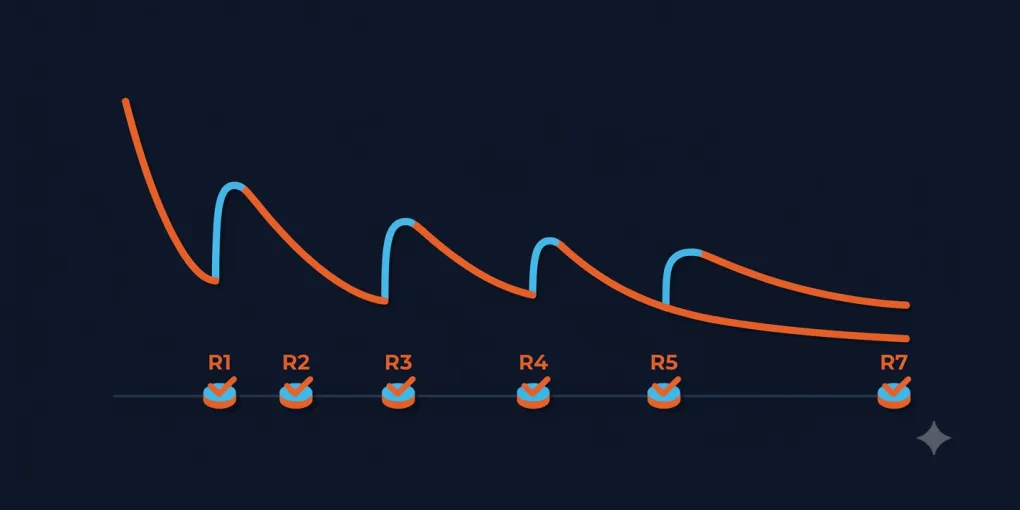
In the 1880s, Hermann Ebbinghaus mapped how quickly we forget newly learned information. The drop is steep: without review, most of what you learn today is gone within days. But each time you successfully recall something, the curve flattens — you forget more slowly, and the memory lasts longer.
Spaced repetition exploits this. By timing your reviews to land just as a memory starts to fade, each repetition does maximum work. Review too soon and you waste effort on something you already know; review too late and you’ve forgotten it and have to relearn from scratch.
Why spacing beats cramming
Cramming feels effective because everything is fresh and easy to recall in the moment. But that ease is the problem — easy recall barely strengthens memory. Spacing deliberately reintroduces a little difficulty (the “desirable difficulty” effect), and that mild struggle is exactly what signals your brain to store the memory for the long term.
For language, this matters enormously. You don’t need a word or phrase for a test next week — you need it available for the rest of your life, at conversational speed. Spacing is what gets it there.
Spaced repetition works best with active recall
Spacing tells you when to review. Active recall tells you how. The two are a package deal.
A passive review — rereading a phrase and its translation — barely counts, no matter how well you time it. A strong review makes you produce the answer from memory first, then check. That retrieval effort is the engine; spacing just points it at the right moment. This is why translating phrases pairs so naturally with spaced repetition: every review is already an act of recall. We go deeper on that in how to learn a language by translating phrases.
How to use spaced repetition in practice
You can run this with paper flashcards, a dedicated app, or a tool that bakes it in. The principles are the same:
- Review daily, briefly. A short session every day beats a long session once a week. Spacing only works if you show up on the days things are due.
- Grade yourself honestly. If a phrase felt hard, it should come back sooner. If it was effortless, push it further out.
- Let intervals grow. A typical progression is something like 1 day → 3 days → a week → a month. Each success earns a longer gap.
- Prioritize what you missed. New material is exciting, but the biggest gains come from rescuing the phrases you’re about to forget.
- Keep sessions small. Ten focused minutes you’ll repeat tomorrow beats an hour you’ll dread.
Don’t build the system by hand
Manually tracking which of hundreds of phrases are due today is miserable, and it’s the part people quit over. The whole point of a spaced-repetition tool is to hide that bookkeeping so you can just practice.
What to review: phrases, not just words
Spaced repetition is most famous for vocabulary, but it works even better on phrases. Reviewing a full sentence rehearses word order, grammar, and natural phrasing all at once — so a single review card does far more work. Pick phrases that match your level; if you’re unsure what that is, see our guide to the CEFR levels from A1 to C2.
How Phrase Rush handles review for you
Phrase Rush is built around review, not one-off drills. You translate real phrases, and the ones you get wrong — or hesitate on — automatically come back at the right time, spaced to fight the forgetting curve. There’s no deck to configure and no schedule to manage; the app tracks your progress and surfaces exactly what you need to see today.
That means every session compounds on the last instead of starting over. Start practicing on Phrase Rush and let the review schedule run itself.
Frequently asked questions
How often should I do spaced repetition?
Daily, in short sessions. The algorithm assumes you’ll clear the phrases that come due each day; skipping days lets them pile up and pushes memories past the point of easy recall.
Is spaced repetition good for beginners?
Yes. Beginners benefit the most, because the early foundation — core phrases and high-frequency structures — is exactly what you’ll build everything else on. Locking it in early pays off for years.
Can I use spaced repetition for grammar?
Absolutely — especially through phrases. Instead of memorizing rules, you review real sentences that contain the pattern, and the grammar becomes automatic through repeated, spaced exposure.