CEFR Levels Explained: A1 to C2 and How to Move Up
If you’ve ever seen a course described as “B1” or a job ad asking for “C1 English,” you’ve met the CEFR. The CEFR levels (A1 to C2) are the international standard for describing how well someone can use a language — and knowing yours makes every learning decision easier, from choosing material to setting realistic goals.
This guide explains what each level means in plain terms, how to figure out where you are, and how to actually move up.
What is the CEFR?
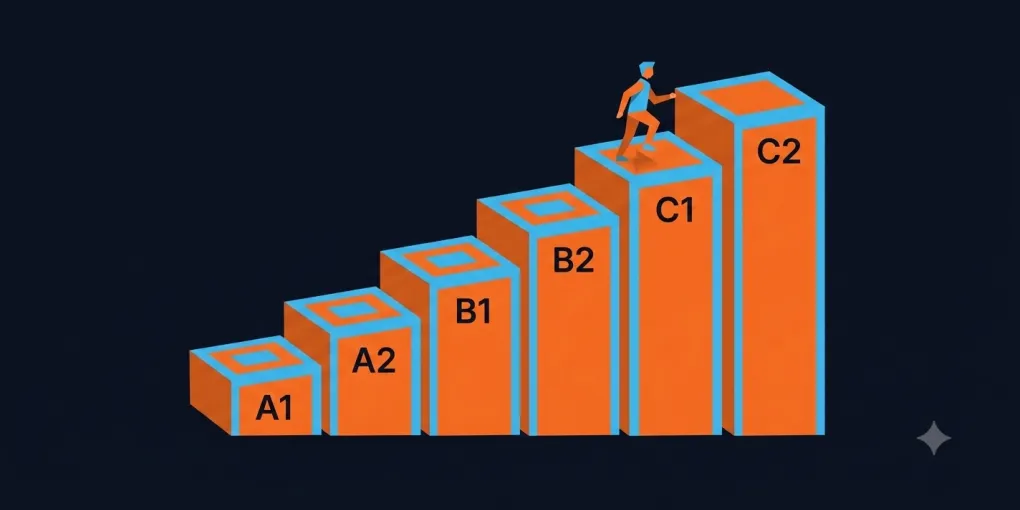
CEFR stands for the Common European Framework of Reference for Languages. It’s a scale used worldwide to describe language ability in terms of what you can do — hold a conversation, read a report, understand a film — rather than how many words you’ve memorized. It has six levels grouped into three bands:
- A — Basic user: A1, A2
- B — Independent user: B1, B2
- C — Proficient user: C1, C2
The beauty of the framework is that it’s task-based. Your level isn’t about a test score in the abstract — it’s about the real things you can handle in the language.
The six CEFR levels in plain language
A1 — Beginner
You can introduce yourself, ask and answer simple questions, and handle very basic, predictable exchanges — as long as the other person speaks slowly and helps you. Think greetings, numbers, and everyday essentials.
A2 — Elementary
You can handle routine situations: shopping, ordering food, describing your background and immediate surroundings in simple terms. Conversations still need to stay simple and concrete.
B1 — Intermediate
The turning point. You can deal with most situations while traveling, describe experiences and plans, and give brief reasons for your opinions. You can follow the main points of clear, standard speech on familiar topics.
B2 — Upper intermediate
You can interact with a degree of fluency and spontaneity that makes conversation with native speakers comfortable for both sides. You can discuss a wide range of topics, follow the news, and argue a point of view. This is often the level employers mean by “fluent.”
C1 — Advanced
You use the language flexibly and effectively for social, academic, and professional purposes. You understand demanding, longer texts, catch implicit meaning, and express yourself without obviously searching for words.
C2 — Mastery
You understand virtually everything you read or hear and can express yourself precisely, even in complex situations, with a command of nuance that approaches an educated native speaker’s.
How to find your CEFR level
You don’t need a formal exam to get a useful estimate. Read the “can-do” description for each level above and find the highest one where you can honestly do everything listed. A quick self-check:
- Struggling to introduce yourself? A1–A2.
- Can travel and chat about familiar things, but complex topics lose you? B1.
- Comfortable in most conversations, occasionally reaching for words? B2.
- Rarely blocked, handling professional or academic language? C1–C2.
Be honest about your weakest skill — many learners read at B2 but speak at A2, because reading is passive and speaking demands active recall.
How to move up a CEFR level
Progress at every level comes down to using the language actively, slightly above your comfort zone:
- Practice production, not just input. Watching and reading help, but moving up requires producing the language — speaking and writing. Translating phrases is a low-pressure way to build that muscle; see how to learn a language by translating phrases.
- Study at “level +1.” Material that’s slightly too hard is where growth happens. Too easy and you coast; far too hard and you stall.
- Make what you learn stick. Moving up means retaining a growing base of vocabulary and structures. Spaced repetition keeps that base from leaking away as it grows.
- Target your weakest skill. If speaking lags, spend your time speaking. Your level rises only as fast as your weakest skill.
How Phrase Rush tracks your level
Phrase Rush is built around the CEFR ladder. The phrases you translate are calibrated by level, and difficulty adapts from A1 to C2 as you improve — so you’re always practicing at that productive “level +1” edge. Instead of points or streaks for their own sake, you climb the actual CEFR scale and can feel yourself moving up.
Start translating on Phrase Rush and find out where you stand today.
Frequently asked questions
How long does it take to go up one CEFR level?
It varies by language, starting point, and hours per week, but a rough guideline is 150–200 hours of focused study per level at the lower levels, increasing at the higher ones. Consistent daily practice shortens the calendar time considerably.
Which CEFR level is considered “fluent”?
Most people mean B2 or C1 when they say fluent. B2 is comfortable, spontaneous conversation across many topics; C1 adds precision and ease in demanding, professional contexts.
Is C2 the same as being a native speaker?
No. C2 is mastery of the language for practical purposes, but native speakers still have cultural and intuitive knowledge that isn’t captured by any level. C2 means you can operate at a very high level, not that you’re indistinguishable from a native.